Computational materials scientist and biochemist.
Builder of simulations.
(and pretty cool guy).
About Karl
A skilled computational scientist specializing in materials science and biochemistry, award winning scientist, and icon in my field (with absolutely no delusions of grandeur…).

Expertise
-
Everything is made of atoms, and those atoms are composed of protons, neutrons, and electrons. The number and distribution of those electrons impart elements with different properties, with combinations of elements and their properties forming the physical world around us.
DFT calculations (in essence) use simplified versions of the Schrödinger equation to conduct mathematical predictions of the ground state (i.e., the ‘home’) positions and energy levels of electrons. Knowing how electrons are arranged, how much energy they have, and how they interact with each other can tell us how the physical material containing those electrons will behave.
We can use these predictions to see how different materials will behave if we mixed in different elements, letting us design things like new alloys that are stronger, more durable, or conduct electricity more efficiently.
-
Think of a sugar cube vs loose sugar. The individual grains of sugar can be combined and stacked together to form an orderly, rigid structure. Materials such as metals do the same thing; their atoms are arranged into organized lattices, with the arrangement of atoms diving the metal its properties.
Like everything else, however, these lattices are not perfect. There are defects like vacancies (‘gaps’ in the organized grid) or substitutions (an atom is replaced by the atom of a different element). Despite being solid, these atoms don’t just stay still; things at the atomic level vibrate and move, we just don’t see it.
Vacancies in the lattice can swap positions with atoms, letting them move around the material. Often, these vacancies will carry atoms along with them, ‘dragging them by the hand’ through the material.
How (and how many of) these vacancies and defects move and congregate changes a material’s properties. For example, some metals can bend and be crushed (aluminum can) while others are very flexible but strong (aluminum on an airplane). This behaviour depends on which/how many other elements are present, as how they group together (or stay apart), and where they group together.
We can use the predictions from DFT calculations to model how things move through a lattice and whether or not different elements will cluster together, changing a material’s properties.
-
Protein structures inform their function. Changes to the protein sequence (amino acid substitutions, deletions etc.) will disrupt the functional structure, altering protein-protein interactions and subsequent functions within cells. While there are many techniques for structural characterization, there might be concerns resolving such structures with high accuracy. Further, structural characterization provides a static image of the protein, which is constantly shifting in reality.
Molecular dynamics simulations provide a rapid method to characterize structural changes, as well as predict structural dynamics in solution. These simulations use robust mathematical frameworks built on known atomic interactions to predict the forces and energies of all atoms in a system. Using principles of thermodynamics (i.e., move towards low energy states) these simulations can predict which conformations are more energetically favourable, and therefore more likely to occur in nature.
Contact Me
I’m always looking for new collaborations and work opportunities. If you’re looking for someone with expertise in computational materials science or computational biochemistry, feel free to reach out!
Recent events
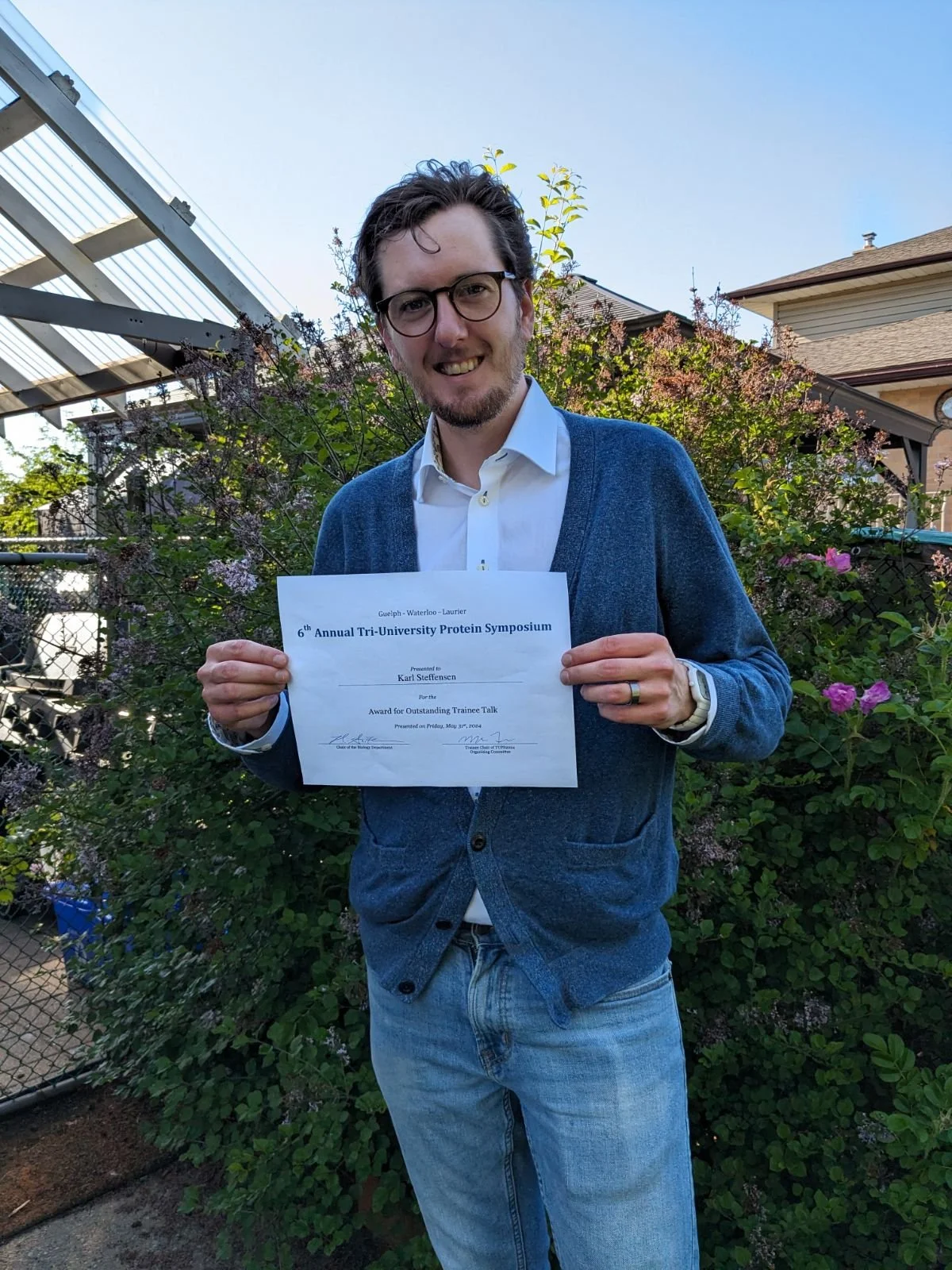
May 31 I presented some recent work on actin variants R312C/H, winning the award for most outstanding research talk (proving that it’s all about choosing the glasses that make you look the smartest)